Search This Blog

Showing posts with label ProGen Study Groups. Show all posts

Saturday, February 20, 2016

South Dakota State Census - "There's Gold in Them Thar Hills!"

Mount Rushmore, SD 1
An assignment in my ProGen class had me re-examining some of my previous work on my great-grandfather. I looked at many of the sources including the South Dakota State Census records. In doing so, I was re-examining the source itself and started gaining a new appreciation for the information within. And the phrase that came to mind immediately was, "There's gold in them thar hills!"

My maternal grandmother's father, John J. Moe, was one of three brothers who emigrated with their parents from Norway to Iowa, and then to South Dakota 10 years later. As adults the three brothers farmed close to each other, although one was in a different county. Between them they had 20 children and over 60 grandchildren.

The three brothers' families have been well documented over the years due to the efforts of several hard-working family members who created hand-written family genealogies in 1961, 1981 and 1996. But I thought it would be good practice to find the South Dakota State Census records for all of the families.

So I spent several hours (more like days) pouring over the state census for these families. And I found some real "nuggets" of information. I highly recommend using this resource if you have family that resided in South Dakota in the first half of the twentieth century. But there's good news and bad news.

First the bad news:
  • The South Dakota State Census records are individual records. There is one card per person in the census. So documenting the source, at least in my family history program, is more work than when all the family members are found in one federal census record.
  • The South Dakota State Census records are filed alphabetically by last name, then first name. The counties are all mixed together. Family members are probably within the same film but are not necessarily filed next to each other unless they have an unusual last name.
  • I found that because of the number of family members I was researching, it was worth my time to navigate to the beginning of the "Moe" records and page through each record. I could have done a search, but this method allowed me to view each record and then focus on those from Brookings and Kingsbury counties. When I tried searching, I found many records didn't show in the results due to transcription errors of the first and/or last names.
  • Like all census records, some of the handwriting is very difficult to read: written in pencil, poor penmanship, too light to discern all the information, etc.

Now the good news:
  • In almost all of the records that I found, the cards for the members of one family were numbered sequentially making it easier to tell if you had the right family member. For example, my John J. Moe family members' census cards were numbered 606 to 615 even though they weren't filed sequentially.
  • South Dakota State Census was taken 1905, 1915, 1925, 1935 and 1945. We have to wait several more years for the 1950 federal census records to be released. But we can see our South Dakota families in 1945 already.
  • All of the state census records are available for free on the FamilySearch.org website (and also with a paid subscription to the Ancestry.com website.)
  • There is wonderful information contained within these census records that is not generally found in federal census records. For example, in the 1915 census:
    • Church affiliation
    • Military Service record: which war (Civil, Mexican or Spanish) and State, Regiment & Company 
    • Maiden Name of wife
    • Year Married
    • Extent of Education and (School) Graduate Of
    • If foreign born, number of years in United States and number of years in South Dakota.
So here are some examples of what I found. The illustration below shows the 10 cards for my John J. Moe family in the 1915 census. You can see that John J. Moe, the top card in the left column, is card number 606 and the rest of the family is sequentially numbered on cards 607 to 615. As I scrolled manually through the census, I watched for Moe's in Kingsbury County, and then could tell by the card number that I had the right family.

1915 South Dakota State Census cards for John J. Moe family2    


And here is a close up of John J. Moe's 1915 census card. Some of the information found is very similar to that found in federal census records. But some of the information is not on all federal records and can give wonderful leads to the researcher.

1915 South Dakota State Census card for John J. Moe3   
Items number 1- 7 are fairly common census items:
Item 1 - his full name
Item 2 - his age
Item 3 - his residence
Item 4 - his occupation
Item 5 - his birthplace & ancestry, his parents' birthplace
Item 6 - basic demographics: gender, ethnicity, marital status
Item 7 - literacy, and you can see my great-grandfather was listed as blind

Gold Nuggets4

Other "nuggets" of information available:
Highlighted in green: Extent of Education including his school
Highlighted in orange: Military Service
Highlighted in yellow: Maiden name of wife
Highlighted in blue: Year married
Highlighted in pink: Church affiliation
Highlighted in purple: Years in U.S. and Years in S. D.


What could I do with these "extra nuggets" information?

Note that the card said "Graduate of" and the response was, "Iowa for Blind." The school for the blind in Vinton, Iowa has gone through a variety of name changes. The name at the time John J. Moe attended was "Iowa College for the Blind." If this was new information for me, I could write to the school to see if there was information about my great-grandfather available.

My great-grandfather didn't serve in any wars but if he did, there would be detail regarding his service, regiment and company that would give me a research lead.

I love, love, love that the South Dakota State Census includes the wife's maiden name. I noted that sometimes the information is filled in on the husband's card, sometimes the information is filled in on the wife's card. This area is often a brick wall for families. The two facts, maiden name and the year married, give the researcher two great clues for finding additional records.

The church affiliation points the researcher toward potential records for baptisms, confirmations, marriages, burials, church memberships and more. All these records either give additional information or substantiate information already found.

In particular, the Norwegian Lutheran Church records give detail that can be very surprising. My maternal grandfather's half-brother was born out of wedlock in Wisconsin a few years before my great-grandparents were married. When I found his baptismal records in the Wisconsin Norwegian Lutheran church records, it named his actual father. Then when I found his confirmation record in the South Dakota Norwegian Lutheran church records, the actual father's name was again listed. I never expected to find his birth father's name so I was extremely surprised to see it in records 15 years apart in two different states.

Panning for gold5 
Lastly, the years in U. S. and years in S. D. give residence information. Where was the family for the first 11 years before they moved to South Dakota? I happen to know that the family lived in Burr Oak, Iowa when they first arrived in the United States. But if I didn't, this information would give me another research question.

If you have family that lived in South Dakota between the years of 1905 and 1945, I heartily recommend "panning" through the South Dakota State Census records. You might also be saying, "There's gold in them thar hills!"


1. “Mt_Rushmore_workers.jpg” by Jake DeGroot is licensed under Creative Commons, accessed 2/20/2016.

2. "South Dakota State Census, 1915," database with images, <i>FamilySearch</i> (https://familysearch.org/pal:/MM9.3.1/TH-266-11686-7124-92?cc=1476041 : accessed 7 February 2016), 004245619 &gt; several images of 3126; State Historical Society, Pierre.

3. South Dakota State Census, 1915," database with images, <i>FamilySearch</i> (https://familysearch.org/pal:/MM9.3.1/TH-266-11686-7124-92?cc=1476041 : accessed 7 February 2016), 004245619 &gt; image 611 of 3126; State Historical Society, Pierre.

4. “Gold_in_Falsche_3.JPG” by Alice Chodura is licensed under Creative Commons, accessed 2/20/2016.

5. GA_gold_panning.pngThis image is a work of the Forest Service of the United States Department of Agriculture. As a work of the U.S. federal government, the image is in the public domain, accessed 2/20/2016.


Sunday, October 4, 2015

More Genealogy Education Goals and My Progress, Part I

After writing my educational goals last January, it became apparent that while they were OK goals, they were't specific enough.

This table below shows the specific skill areas that I feel I need to grow. I'm very comfortable with many record types but recognize that I need to learn more about many others.

There are also some research skill areas I need to improve on. I've been searching on the Internet for over twenty years, now I need to research on the Internet. That is, I need to make my searches more concentrated toward a specific task rather than blind searches for whatever may pop up. Sources and citations will be an area that I need to continually work on.

The geographic locations are areas that apply to my personal research and that may change and grow as either new information in uncovered or as I help others in their research.

And the writing skills are the areas I would like to improve in before I publish my ancestors' stories.


Record Types

Research Skills

Geographic Locations

Writing Skills
Land and property

Sources and citations

Northeast: New York,
Pennsylvania, Vermont,
Massachusetts
Beyond the family tree
Wills and probate

Maps and plat books

Midwest: Ohio, Illinois

Using historical context
Historical law

Online searches

Europe: Czech Republic
Editing
DNA

Finding female ancestors

Scandinavia: Iceland, Norway
Copyright
Federal records


Layout and publishing

After I made this table, I started listing ways that I might start building those skills and turned them into long-term goals (not just goals for 2015).
  1. I will read scholarly journals.
  2. I will attend a genealogical institute. 
  3. I will attend one or more conferences.
  4. I will participate in webinars. 
  5. I will continue to build my library, read books and participate in book studies. 
  6. I will work with unfamiliar record types.
  7. I will keep a record my educational activities and evaluate them quarterly.
The seventh goal, "I will keep a record my educational activities and evaluate them quarterly," is actually the reason behind this post. I have been very faithful in recording my activities this year. What follows is my evaluation of the work I have done in the last 6-7 months toward building those skills.

I use Excel to track my educational activities. Tabs across the bottom of the workbook are labeled:
  • Webinars
  • Institutes
  • Conferences
  • Book Studies
  • Article Studies

The columns in each worksheet are similarly labeled but vary slightly for each activity type. Typical column headings are:
  • Date - the date I participated or viewed
  • Sponsoring Organization - conference, institutes, or society sponsoring event
  • Presenter - name and credentials, if known
  • GenTopic - general genealogy topic, say "Research Skills"
  • SubTopic - topic sub-category, say "Online Searches"
  • Length - time spent viewing or attending
  • Handout - link to downloaded handout (organized on my computer)
  • Notes - link to notes taken (organized on my computer)
  • Rating - mini-review on topic and/or speaker

Goal 1- "I will read scholarly journals."

I have probably tripled the amount of time I spend reading journals as compared to years past. However, I need to spend more time studying the articles. I joined an National Genealogical Society Quarterly (NGSQ) Study Group and need to make an effort to schedule myself accordingly. These are the journals I subscribe to:

Goal 2- "I will attend a genealogical institute."

I met this goal by attending IGHR, Institute of Genealogy and Historical Research, in June 2015. I could stop there and just say I met this goal. But instead I want to encourage anyone who might read this to participate in IGHR or one of the other institutes available. There are several including:
  • GRIP, Genealogical Research Institute of Pittsburgh
  • SLIG, Salt Lake Institue of Genealogy
  • NIGR, National Institute on Genealogical Research
  • IGHR, Institute of Genealogy and Historical Research
There are also institutes on genetic genealogy and one or more virtual institutes. If there are others, I would love to hear about them as I have heard nothing but wonderful things about each of the ones listed above. And my own experience was beyond expectations, one of the best values for my genealogy dollars.

The list of speakers at the week-long IGHR in June reads like a "Who's Who" in genealogy expertise. The coordinator of the Intermediate Genealogy & Historical Studies course that I took was Angela McGhie and I cannot say enough about how much I enjoyed the course. I also learned so much from Angela and her guest speakers. Fun & learning - you can't beat that! Speakers (and their topics) during the week-long course included:
  • Thomas W. Jones (Using Evidence)
  • Debbie Parker Wayne (Tax Rolls; DNA)
  • Kimberly T. Powell (Online Searches; Manuscript Collections)
  • John Phillip Colletta (Immigration & Naturalization)
  • Gerald Smith (Local & State Land Records)
  • Michael Strauss (Military Records)
  • Judy G. Russell (Court Records)
  • Angela McGhie (Essential Skills; Vital Record Alternatives; Advanced Census Research; Federal Land Records; Historic Newspapers; Wills and Probate; Evidence Review, Techniques)
The session topics were very closely aligned to my genealogy goals, particularly in Record Types and Research Skills, so I feel that this course was especially suited for me and my goals.

I plan to attend another Institute in the coming year. Because I have family in Birmingham, it may be IGHR as 2016 is the last year it will be held at Samford University. But I have heard such wonderful things about SLIG, GRIP and NIGR; it's a very tough decision.

I will continue my evaluation of my progress toward my goals in Part II.

Saturday, October 3, 2015

Reaching for My 2015 Genealogy Education Goals

It's been months since my last post, but they were busy months. My last post was on my 2015 Genealogy Education Goals and this post will look at how I am doing so far.

The last post ended with these goals: I will...
  1. make it to the end of 2015 still up-to-date with all my readings and homework in ProGen 25.
  2. successfully complete Mastering Genealogical Proof Study Group 37.
  3. learn to critically read articles in professional genealogy registers.
  4. follow the GenLaw Study Group on Dear Myrtle's YouTube channel.
  5. continue to add to my research library.
  6. visit at least one courthouse for research.
So let's see what I've accomplished so far and what I need to do to accomplish those goals.


The first goal was to be up-to-date with readings and homework in ProGen 25. ProGen is an 18-month study course for learning professional genealogy research skills by reading and collaboratively studying the book, Professional Genealogy by Elizabeth Shown Mills. October 2015 marks the 8th of 18 months and I am proud to say I am up-to-date so far. I am a co-leader of our Wednesday group and it is a wonderful learning experience. Even though we are just under half-way through the course, I would recommend this course for anyone considering genealogy as a field of practice or study.


Goal #2 was to successfully complete the Mastering Genealogical Proof Study Group 37. This study group studied and discussed the Thomas W. Jones book, Mastering Genealogical Proof for approximately 12 weeks. I had previously followed two of Dear Myrtle's study groups of the same title and so was familiar with the book. Even so, this group study was challenging as the topic is complex. But it is a critical piece to the professional genealogist's toolbox. I was successful at this goal also and was recently rewarded with a certificate of completion.


The third goal was to learn to critically read articles in professional genealogy journals. I will be the first to say I am not an expert. However, I find that looking at the appendix articles in in the Mastering Genealogical Proof Study Group has changed the way I read articles. When I first started reading journals, I only read articles that I thought pertained to my research. Then I started reading other articles but I only glanced at the footnotes or endnotes while reading the article. Now, the footnotes and/or endnotes are first thing I look at. I try to read more critically and see if I agree with the author's conclusions. And when I find an article that covers an geographical location or topic that I am particularly interested in, I note the sources in the articles in case they may have information that I need. I joined an article study group but have only met with them one time due to scheduling issues on my part. I hope to continue to meet as this is an skill I need to grow.


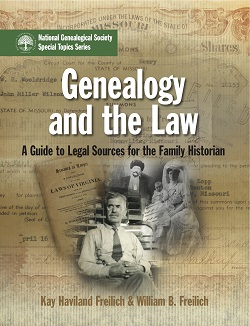
Goal #4 was to follow the GenLaw Study Group on Dear Myrtle's YouTube channel. This study group read and studied the book Genealogy and the Law by Kay Haviland Freilich and William B. Freilich. I did follow through with this goal but recognize that this is an area that I need to grow in, also. What I appreciate about following the study groups with Dear Myrtle is that they are very non-threatening but still rigorous. That is, as rigorous as the follower wants to be. You can study along with the group or just observe. So it is a great introduction to the more difficult topics.


The fifth goal is always a fun thing for me. I love collecting so building a genealogy library was not a chore at all. Of course, I need to build it somewhat slowly as I can't afford to buy all the books I want at once. The book mentioned above, Professional Genealogy, has a wonderful list of sources and recommended reading at the end of each chapter. I used these suggestions when building my library. When available, I purchased or found ebooks online. But my library already fills three tall bookcases. So far I have catalogued about 80% of the books and plan to do the rest soon if for no other reason than to prevent duplicate purchases.

And as for goal #6: so far I am a dismal failure. Although I have broadened my knowledge by attending at least three lectures on the topic of courthouses and legal records, I have yet to visit a courthouse. I still have about 90 days so it is still something I hope to check off my to-do list.

I also created a more detailed list of topics and skills that I need to improve on, and will share that list and my 6 month progress toward those goals in my next post.